
In recent years, electromyostimulation (EMS) technology has brought about a significant transformation in the fitness sector. EMS is a method based on the principle of stimulating the muscles electrically and promises to help users achieve more effective results in less time. This technology offers a time-saving alternative, especially for people with busy lifestyles. As a result, business models such as opening EMS studios or adding EMS to existing gyms have become attractive to investors.
In this article, we compare adding EMS to a gym with opening a new EMS studio in terms of profitability. Taking into account factors such as the revenue potential of the two models, operating costs and market demand, we look at which one may be more advantageous. As a fitness investment idea, EMS has the potential to deliver great returns with the right analysis and strategy.
Some entrepreneurs, considering the growing interest in EMS technology in line with changing market dynamics and user demand, prefer to add EMS to existing gyms. Others want to offer this innovation under their own brand by opening a completely new EMS studio. Both options have their own advantages and challenges. In this article, we examine these factors in detail and aim to guide readers on which model may be more profitable.
What Is EMS?
Electromyostimulation (EMS) is a technology and method used to make muscles contract by stimulating them with electrical currents. EMS is widely used in sport and rehabilitation. Its basic principle is to create activity by targeting muscle fibres with electrical signals, similar to natural muscle movements. This process helps the muscles work more efficiently and indirectly helps increase muscle strength.
One of the biggest advantages of the EMS method is that working the muscles requires less physical effort. This can be particularly beneficial for people who are new to physical activity or have certain health problems. It can also be integrated into athletes’ training programmes to improve performance. For entrepreneurs who want to open an EMS studio, presenting the benefits of this system effectively is critical.
Adding EMS to a gym aims to offer existing members a new experience while also attracting new customer groups. EMS’s target audience includes a variety of groups such as people in rehabilitation, older adults and people just starting out in sport. This diverse target audience increases the growth and profitability opportunities of gyms and studios. As a fitness investment idea, EMS therefore not only increases muscle strength but also has a positive effect on users’ overall health and quality of life.
Advantages of Opening an EMS Studio
Opening an EMS studio is a notable investment opportunity in the fitness sector. This type of business offers high profit margins with low operating costs. Requiring less equipment than conventional gyms, EMS not only helps you minimise high costs at the start but also offers the opportunity to earn more profit. Because EMS studios generally require smaller spaces, rent and other fixed costs also remain lower.
In addition, EMS studios have the potential to create high customer satisfaction thanks to the fast, effective results they deliver. EMS devices make the muscles work in a shorter time and are very effective in helping people reach their goals. This is an important factor for customer loyalty and word-of-mouth marketing. Given the growing demand for healthy living and fitness, EMS studios can keep up with this trend and position themselves at the forefront of the market.
In addition, adding EMS to a gym is an opportunity for gym owners to diversify their existing business and increase their potential customers. Interest in EMS training offers the opportunity to reach more customers and serve a wider audience. This creates new fitness-based opportunities for investors. In conclusion, opening an EMS studio or adding EMS to an existing gym can be beneficial both financially and operationally.
Adding EMS to an Existing Gym: Benefits and Challenges
Adding EMS (electromyostimulation) to an existing gym is a very attractive alternative as a fitness investment idea. Like opening an EMS studio, adding EMS systems to an existing gym has many advantages. First, workouts using EMS equipment deliver effective results to customers in a shorter time. This increases the gym’s customer satisfaction and allows it to attract more members.
In addition, EMS workouts usually require less time. By offering customers short sessions of around 20–30 minutes, you can increase the use of your gym. This allows you to run more sessions in your existing gym, which can help you increase your revenue. EMS equipment also makes it possible to work a number of muscle groups at the same time. This makes it possible to create customised programmes for the needs of different gym members.
When all these advantages and challenges are taken into account, adding EMS to an existing gym is a decision that requires careful assessment and planning.
Profitability Comparison
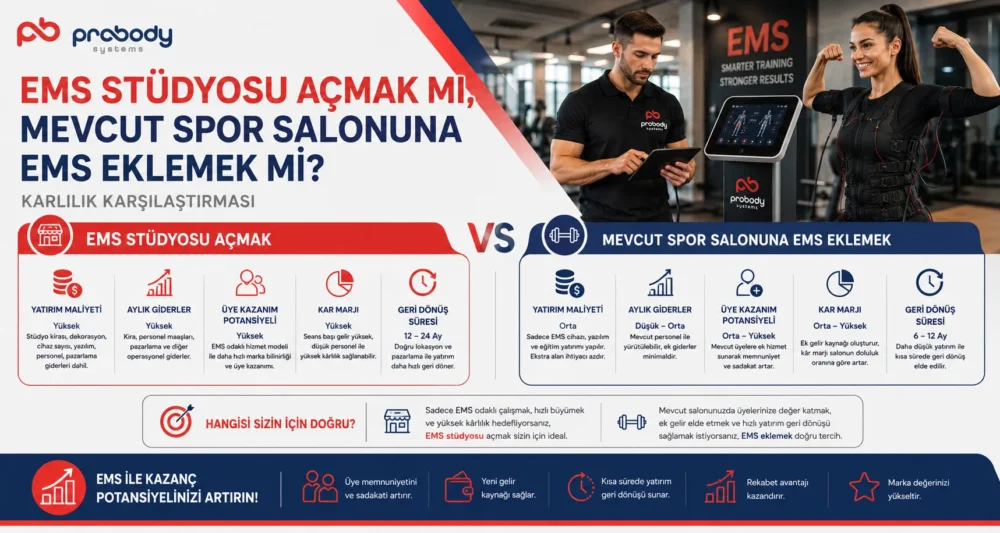
The profitability of opening an EMS studio and adding EMS to an existing gym differs when assessed using various financial indicators. First, let us look at the revenue structure. Because EMS studios usually charge higher prices, they may have the potential to optimise costs and increase the number of customers. For example, the price of an EMS session can be up to twice that of a conventional fitness session. This can allow revenue to grow quickly.
On the other hand, adding EMS to an existing gym makes it possible to generate more revenue with less risk by drawing on the existing customer base. The need for intensive marketing to win new customers is reduced. In this case, the gym’s operating and infrastructure costs must also be taken into account. EMS equipment can be a significant burden in terms of initial investment and maintenance costs. The key question is therefore the payback period.
For example, the initial investment cost of an EMS studio can be high, including rent and staff costs as well as equipment. However, with a premium pricing strategy, these costs can be recovered in a short time. By contrast, although adding EMS to a gym requires a lower investment, the payback period may be longer because it provides a smaller marginal gain. In general, both business models should be assessed in terms of their own opportunities and risks, and decisions should be based on financial forecasts.
Target Market Analysis
Fitness investment ideas such as opening an EMS studio or adding EMS to an existing gym take into account the potential of a broad target market. First, young people are the group showing the most curiosity about and interest in this new training method. With their fast-paced lifestyles, young people are turning to more effective, shorter workouts. EMS technology attracts the attention of this young customer base and offers them a practical solution for reaching their fitness goals.
Active athletes can also benefit greatly from this technology. Athletes can turn to EMS studios to improve their performance and speed up muscle recovery. This system allows athletes to increase their strength and recover faster. Adding EMS to existing gyms therefore creates an opportunity to target this group and offer them a more comprehensive service.
People who need rehabilitation are also potential customers who can benefit from EMS. With the growing older population, people looking for low-impact exercise methods have the opportunity to increase their muscle strength and endurance with the advantages EMS technology offers. This group may choose to go to an EMS studio or an existing gym both to maintain their physical health and to carry on their daily lives more comfortably.
In conclusion, opening an EMS studio or adding EMS to a gym offers a broad target market, from young people to older adults and from active athletes to people needing rehabilitation. Understanding this wide range of customers is critical to the success of the business.
Introduction
Opening an EMS studio or adding EMS to an existing gym is an investment idea that looks attractive at first. However, correctly calculating the investment and resources required for such a venture is critical to success. Whether you aim to open a new studio or integrate EMS equipment into your gym, both options have different cost structures and resource requirements.
Required Investment
The start-up costs of opening a new EMS studio are usually high. The main reasons are the need for high-quality equipment and the need to rent suitable premises. Because EMS equipment is high-tech, it can be a significant financial burden. The necessary software systems and online booking platforms should also be considered in this process.
Adding EMS to an Existing Gym
Although adding an EMS service to an existing gym may initially seem cheaper, it is important not to overlook some basic requirements. Factors such as the suitability of the existing space, equipment purchases and EMS training for gym staff will influence the choice. Setting aside additional budget for marketing the new service and introducing it to existing members is also an important step.
Training and Resources
Both opening a new EMS studio and adding EMS to an existing gym require qualified staff and training. Employees having sufficient knowledge of EMS technology plays a major role in improving service quality. Training programmes and certification are among the critical requirements in this process.
Conclusion
Both options require certain investments and resources. By carrying out a review, it is possible to determine which investment will be more advantageous in terms of profitability. With the right analysis and planning, these processes can be made more successful and profitable.
Marketing Strategies
Defining effective marketing strategies is very important for opening an EMS studio or adding EMS to an existing gym. The first step is to identify the target audience accurately and develop ways to reach it. In this context, it is necessary to understand potential customers’ needs, lifestyles and sporting interests. In the light of this information, suitable marketing channels and communication strategies can be defined.
Social media is one of the cornerstones of modern marketing strategies. Platforms such as Instagram, Facebook and X are effective tools for promoting EMS studios or gyms. On these platforms, engaging content can be created by sharing information about adding EMS to a gym or opening a new studio, as well as participants’ success stories and past workouts. Visual content is extremely effective at attracting the attention of potential customers.
Promotional campaigns are another important element to consider. Especially in the early stages, offering free trial classes and attracting new customers with discounted memberships or referral programmes is a smart approach. Such strategies allow people to experience EMS training, thus increasing their participation.
In addition, taking part in local events or health fairs will help build brand awareness when opening an EMS studio or adding EMS to an existing gym. Such events are an effective way to reach potential customers and appeal to a wider audience. All of these marketing strategies are critical not only for promoting your services but also for building customer loyalty and growing your business.
Recommendations
Opening an EMS studio or adding EMS to an existing gym offers attractive options for many entrepreneurs as a fitness investment idea. Both models have different advantages and disadvantages. Those considering opening an EMS studio can take the opportunity to reach a more targeted customer base, while those who want to add EMS to a gym can meet existing members’ needs and offer new services.
First, it is important to consider the costs and operational requirements of opening an EMS studio. Entrepreneurs need to make a comprehensive assessment of the knowledge, experience and financial resources needed for this type of business. Because of the high initial investment and special equipment requirements, opening an EMS studio can be seen as a risky option. However, these risks can be minimised with a good business plan and proper market research.
On the other hand, adding EMS to an existing gym may be more advantageous in terms of reducing risk by evaluating members’ feedback and optimising membership systems. Adding EMS to gyms offers the chance to create an additional revenue stream and reach a wider customer base, while start-up costs may be lower. However, when evaluating this model, it should not be forgotten that it must fit the gym’s corporate identity and customer base.
In short, when deciding which model is more suitable, entrepreneurs need to take a broad perspective on risks, costs and customer demand according to their own situation. Knowing the opportunities and challenges both options can bring is the foundation for making a sound and profitable investment.
